Essays ·
Three Regulars and a Hokkien Mee Stall
A Serangoon Hokkien mee stall closed after 32 years. Its story is best told from the tables, through three of its customers.
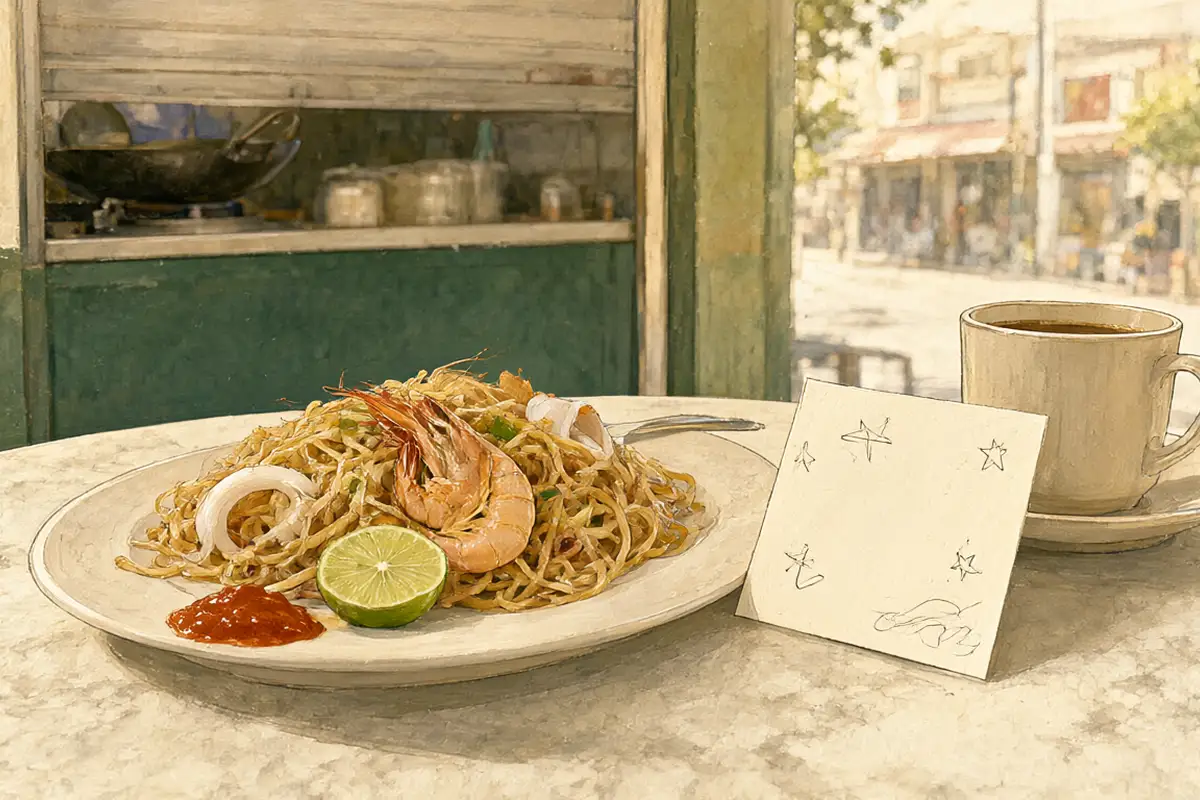
Most stories about a closing stall are told from behind the wok. This one is better told from the tables.
Chang Cheng Hokkien Mee served its last plates of fried prawn noodles on 31 October, at Yu Xiang coffee shop in Block 237 Serangoon Avenue 3. Mr Wu Fushun, 64, and his wife, Mdm Lin Rongduan, 61, had run it for 32 years. They worked six days a week, more than 10 hours a day. The years wore down Mr Wu's health, so they chose to stop. (Lianhe Zaobao, from Shin Min Daily News)
I wish them a long and easy rest. They have earned it.
What caught my eye, though, was not the couple. It was three of their customers.
The girl who was recognised
The first is an 11-year-old girl. Her parents had eaten at the stall since before they married. When she came along, they brought her too.
Before the stall closed, she wrote the couple a card in Chinese. To some people, she wrote, it was just an ordinary little stall. To her it had good noodles, and it had 人情味 – the warmth that comes from people who care about you. She thanked Auntie in particular, because every time she came, 您总是能认出我: "you always recognise me." She signed off as an 11-year-old girl who loves their fried prawn noodles. Mdm Lin took the card home as a keepsake.
Read it again. She names the food first. Then she names being known.
That second thing is in no recipe. It took 11 years to build – longer, if you count her parents' courtship.
The regular who did not come back
The second customer was a man in his eighties. Mr Wu had known him for more than 30 years. Then, some time ago, he stopped coming. Mr Wu assumed his age made it hard for him to get out.
The truth came in the stall's final days. The man's daughter made a special trip to say goodbye, with a box of chocolates. Her father had died a month earlier. Mr Wu said their eyes welled up when she told them. They had grown close over the years.
Think about what that tells us. A hawker notices when a regular goes missing. For an older regular, the stall downstairs may be one of the few places where someone notices an empty seat.
We count hawkers by their age, their rent and their income. We have no count for this.
The ones who came back at the end
The third customer is a crowd. In the final week, Mr Wu said, business rose by 50 per cent. Regulars they had not seen in years came back to say goodbye. Some brought gifts and handwritten cards.
I do not say this to scold anyone. Most of us know the pull. A closure notice turns a plate of noodles into a last chance, and we queue for last chances.
Still, the sums are uncomfortable. If the couple took no holidays beyond their weekly rest day, they stood at that stall for close to 10,000 days. That is about 100,000 hours. The rush of thanks came in the last week.
What a stall keeps
Our debates about hawker heritage, mine included, are mostly about the cook. Who will learn the dish? Who will take over the wok? Those questions matter. I have written about them here and here, and I will again.
But a stall also keeps a record that nobody writes down. Which couple courted over its noodles. Whose daughter has grown up. Which old man has stopped coming, and why. When the shutters come down for good, that record leaves with the couple.
A machine can already fry Hokkien mee. One Margaret Drive stall bought a robot wok after failing to hire a chef, even at up to S$4,000 a month. It closed after about 10 months, because it still needed people to make the stock and peel the prawns. Even when the machines get better, I doubt one will remember an 11-year-old's face.
To be sure, this record cannot be saved the way a recipe can. Nor should it be. It belongs to the people in it.
What we can do is notice it while it still exists. That is the idea behind the Regulars' List in our Plan. A regular is a named person who orders from a stall at least once a week. When 20 of them endorse a dish, it earns a place on the list and a decal at the counter: a dish this neighbourhood wants kept. It is a compliment from diners, never a diagnosis.
Granted, it would not have helped here. The List starts at government hawker centres, and Chang Cheng sat in a coffee shop. Coffee shops come in only by exception. That is a gap in our own Plan. Nor could any list have spared Mr Wu's health.
Still, it would have put a number on what the girl's card says. A neighbourhood wanted this dish kept, and it said so while the stall was still open.
Write your card early
So here is my ask, and it is a small one.
Think of the stall where you have eaten the longest. Write the uncle or auntie a card this month. Do not wait for the notice to go up. Give it to them now, while they can still fry you a plate and ask after your mother.
If you do, tell me about it.
To Mr Wu and Mdm Lin: thank you for 32 years, and good health to you both.
– Uncle James, a 45-year-old who loves his Hokkien mee