Essays ·
One Less Place to Taste Our Heritage
Lao Liang’s closure leaves a gap in Singapore’s Teochew food heritage, with no announced successor to carry on its cooking.
Another traditional Teochew stall has closed. This time, it is 老两猪脚冻 at Berseh Food Centre.
Zaobao’s report on 30 October described regulars queuing for a final taste before the stall’s closure the following day. Its husband-and-wife owners, both 75, were retiring. The wife hoped to visit Shantou with her children after more than forty years without travelling overseas.
I hope they enjoy that trip. Yet I find it difficult to read this as simply a happy retirement story.
Singapore has lost another place where a particular family’s Teochew cooking was still being practised and served.
An earlier Zaobao report traced the business to the owner’s grandfather, who brought the dish here after running a Teochew restaurant in China. The couple’s children have their own careers and will not take over. The reporting describes a closure, with no sale or successor announced.
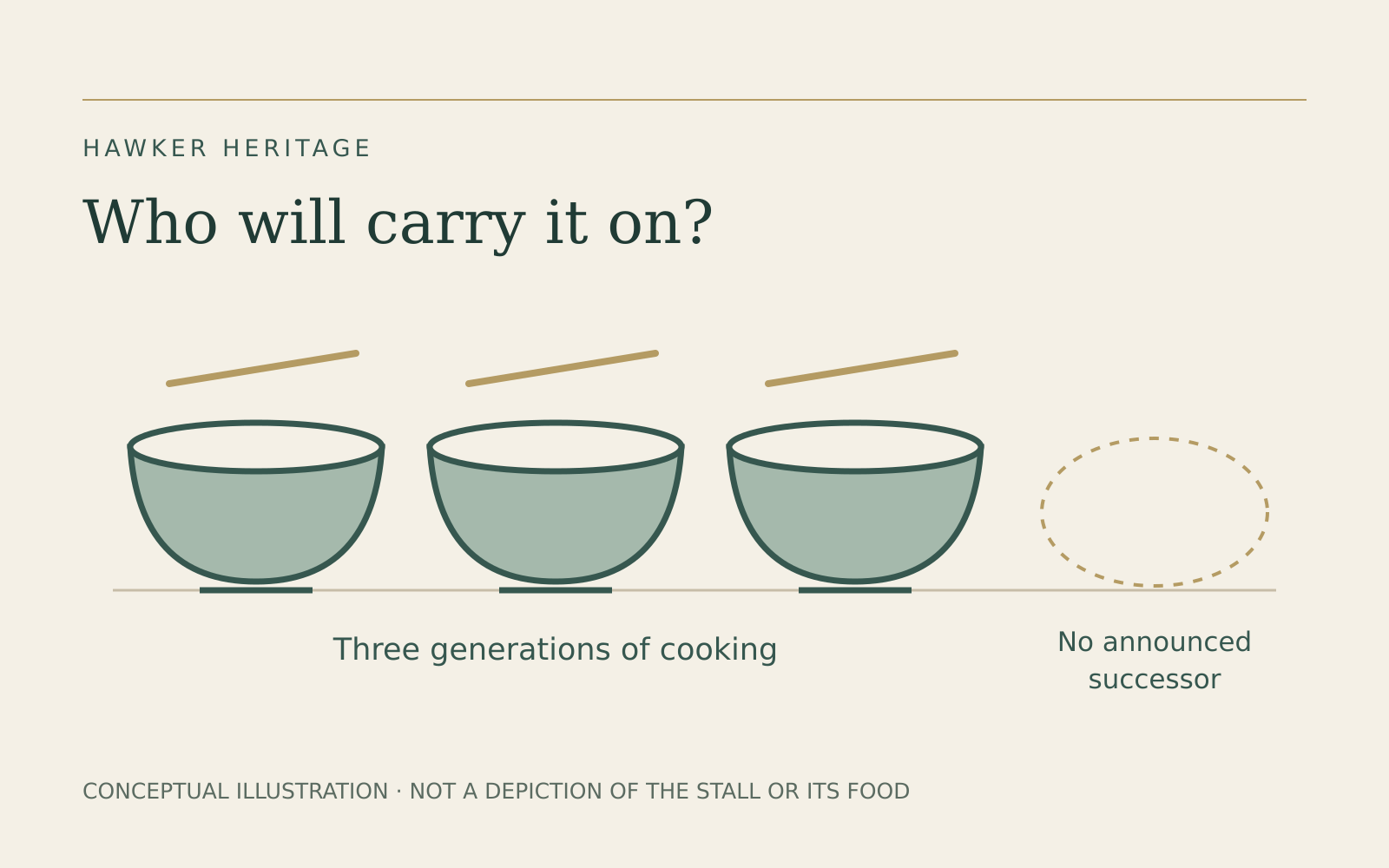
Three generations brought the food this far. There is no announced fourth to continue serving it.
What makes this worth mourning is the particular cooking that leaves with them. Their pork trotter jelly was set through slow cooking that extracted the natural gelatin, without ready-made gelatin powder. Their Teochew kway chap had a lighter broth, made with pork bones, Chinese yam and Bentong ginger. These were recognisable choices within a family tradition.
Another stall can sell pork trotter jelly or kway chap. It will not taste quite the same anymore.
I keep thinking about Singapore’s falling total fertility rate (TFR). There is an uncomfortable irony here: our hawker heritage seems to be following the same path. We worry about whether the next generation will be large enough to replace us. Yet our traditional cooks are retiring without successors to replace them. We have no equivalent ‘heritage TFR’, but the question is familiar. Who will carry on when this generation stops? A hawker centre can remain full even as the traditions practised within it fail to renew themselves.
Culinary knowledge can pass to children, apprentices or several unrelated cooks. One teacher can leave many successors.
But someone has to learn it, or at least document and record it for future generations.
A new tenant may run an excellent business. The food may be popular. Neither tells us whether the departing hawker’s knowledge has found another pair of hands.
The tables can stay full while the culinary repertoire shrinks.
To be sure, this closure does not mean Teochew cuisine has disappeared from our hawker scene. Nor do we know whether the couple might have passed on their techniques in private with others. What has surely ended is their daily contribution to our hawker landscape, with no publicly identified successor.
That is a loss we should acknowledge plainly.
For regular customers, it means one less place to return to. For someone who has never tried the food, it means one less opportunity to discover it. Over time, fewer people may even know what they are missing.
That last part troubles me most.
My children can ask me about a place I remember. I can show them photographs and describe the food. But my recollection cannot give them the experience of eating it. Eventually, even the people who remember the difference will be gone.
Still, we should wish these hawkers a good retirement without making them responsible for our sadness. They have carried the tradition through their working lives. Their children are entitled to choose different ones.
Even then, we should resist treating the closure as an ordinary change of tenancy. A hawker business ending without a culinary successor leaves something behind that a new signboard cannot replace, and further erodes Singapore’s UNESCO-inscribed hawker culture.
What the Plan could make possible
If support of this kind had been available early enough, and the couple had wanted it, the Plan could have offered ways to carry this cooking forward. These are proposals, not current entitlements or a claim that Lao Liang took part; none could guarantee a successor. Retirement and their children’s choices must remain theirs.
When the next retirement story appears, I hope we ask who will continue cooking when that stall closes. If nobody will, let us acknowledge the consequences of inaction to our hawker culture.
For Lao Liang’s regulars, there is now one less place to eat the food they grew up with. For the next generation, there is one less place to learn what it tasted like.